
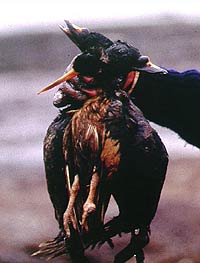
SeabirdsThe threats to seabirds were; being killed for meat, eggs and feathers. Today, modification of breeding habitats, oil spills and introduced feral animals are among the threats that can impact considerably on seabird populations. More recently, the global expansion of longline fisheries has begun to pose the greatest overall threat to seabirds.
|
 Longline fishing is a method used to target finfish and shark species. A longline consists of a main line with numerous baited hooks attached to branchlines. The line can be set parallel to the surface or on the sea-bed. The number and type of hooks and the length of the branchlines, depend on the target species. Longlines can be up to 100 km long and have up to 10.000 hooks. Each year, thousands of seabirds are accidentally killed on longline hooks when birds ingest baited hooks during the setting or hauling of the longline. Birds hooked are subsequently pulled under the water by the weight of the line and drown. The level of mortality that occurs in longline
More about:
Habitat loss and degradation are threats African birds have to deal with.
Air pollution and human activities are the threats birds have to deal with in America.
The majority of Asian birds lives in forrests. These forrests are threatened by conversion to other land-uses and overexploitation. Therefor the birds are threatened by the same dangers.
Carrabean birds are threatened by erosion of pristine habitats and illegal trade of the birds.
Hunting and economic development are the majority of the causes that lead to death of birds in Europe.
On the pacific, habitat destruction and 'invasive alien species' are the larges threats.
|
News about airborne animal species |