Home Other Elephants

Elephants

In 1930, there were between 5 and 10 million African elephants. The Africa elephants were added to the international list of the most endangered species in 1984. By then, there were only about 600.000 remaining. This is less than 1% of their original number. Asian elephants are even more endangered than African elephants. At the turn of the century, there were an estimated 200.000 Asian elephants. Today there are probably no more than 35.000 to 40.000 left in the wild.

elephantHumans have become the biggest threat. Elephants are mainly threatened because of their ivory and habitat loss. Ivory is known as ‘white gold’ because it is beautiful, easily carved and durable. Most of the world's ivory is carved in Japan, Hong Kong, and other Asian countries. Skilled carvers depend on a supply of ivory for their livelihoods.

Even thought hunting elephants is no longer legal in many African countries, poaching was widespread until very recently. As the price of ivory raised, poachers became more organized, using automatic weapons, motorized vehicles and airplanes. Thousands of elephants have been killed because of poaching. Poaching has caused the collapse of elephants social structure, as well as decimating their numbers. The worst thing of the poaching is that the poachers often kill all the adults in the group, leaving young elephants without any adults to raise them.

The African government now takes action to protect the elephants. The main reason they are takinh action, is because they have realised elephants are very important for the economy of Africa. A lot of tourists visit Africa because of the elephants.


More about:

Rhinos have an ivory horn. Therefor rhinos are hunted. They are also threatened by habitat loss.

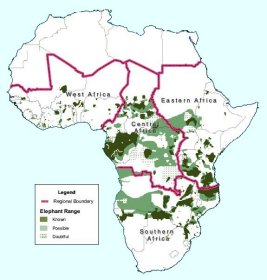
Living area elephants

Living area elephants

This is the living area of the African elephants. 

News about elephants


Congo Basin passes 1 million ha milestone in swing to sustainable forestry - © WWF-Canon / Martin Harvey" border="0" align="left" hspace="4" vspace="2" />Yaoundé, Cameroon - WWF today announced that more than one million hectares of Congo Basin forests have achieved certification under the world’s leading sustainable forestry scheme. The world’s second largest block of rainforests, the Congo Basin is a haven for indigenous peoples and endangered species like elephants and gorillas. It is also important in sequestering carbon and safeguarding water supply and quality. “With rampant illegal logging, vague logging concession boundaries and massive blocks of pristine forest destined for the chainsaw, this is a laudable step towards avoiding an ecological disaster,” says James P. Leape, Director General of WWF. Forest Stewardship Council (FSC) certification has now been achieved for forestry operations on 1.2 million hectares, a significant step towards WWF’s Green Heart of Africa network initiative goal of having certification achieved for 50% of production forest in the Congo Basin. The certification involves logging companies SEFAC, Transformation Reef Cameroon (TRC) and WIJMA in Cameroon and CIB in the Republic of Congo. “While the certified forests will have to be maintained according to acceptable international standards, there is urgent need for other timber business operations in the region to adopt responsible forest management practices in order to ensure the conservation of this unique forest ecosystem for the benefit of people in the region and the world,” added Mr. Leape. To promote responsible forest management and trade in the Congo Basin, WWF-CARPO has set up the Central Africa Forest and Trade Network (CAFTN), a part of WWF’s Global Forest & Trade Network (GFTN) – which works to provide support, advice and guidance to logging companies to help them better understand how good logging practices can contribute to conservation of biodiversity, improve the livelihood of local communities and lead to a market advantage. “Illegal forest exploitation and forest crimes are largely due to poor governance and insufficient law enforcement,” said Laurent Somé, WWF Central Africa Regional Programme Office (CARPO)'s Representative.. “WWF also recognizes that responsible forest management plays an important role in the economic growth of tropical countries and reducing poverty in forest communities. “WWF is convinced that the adoption of responsible forestry schemes by logging companies will contribute greatly to the conservation of the Congo Basin forests and towards improving the national economy and also improve the livelihoods of local communities,” Mr Some said. “For the success of responsible forestry in the Congo basin, there is a high need for government to set up enabling conditions that include enacting adequate legislation and enforcement, and promoting good governance while providing support to responsible forestry initiatives.” By 2012, WWF expects that 7 million hectares of forest in the Congo Basin will be under credible certification while another 5 million hectares will be progressing towards credible certification.